Learning a new language can be a tough. What’s even more difficult is raising a child in multiple languages that we are still learning ourselves. Sometimes we wonder, “Will my child even be able to speak this language?” or “Am I enough?” I can’t tell you how many times I’ve asked myself these questions. It can be especially discouraging when the community language seems to dominate your child’s vocabulary and it looks like your child isn’t making much progress in the minority languages you’re using at home. Self-doubt can creep in so fast and if it gets to you, you can get overwhelmed so fast.
But let me tell you something. Language acquisition happens in meaningful contexts. It doesn’t happen through grammar drills, workbooks, or overnight.
“The child absorbs everything in his environment; he does it without effort, and passes from the unconscious to the conscious stage by means of experiences in the environment.”
– Maria Montessori, The Absorbent Mind, Chapter 7: “The Absorbent Mind and the Environment”
I think this quote encapsulates what it means to learn languages: not passively, but actively through meaningful everyday experiences.
Once I heard a world language teacher say something that stuck with me. To paraphrase:
“If you practice completing written grammar drills, you’ll get good at completing grammar drills. If you practice speaking in the language, you’ll get good at speaking the language.”
The language experiences that we do matter. We take in these experiences and ultimately construct what we’re going to do with the language. While toddlers are too young to experience the traditional ways of acquiring a language, it’s important to ask: What experiences are we giving our children? Are they rich in interaction, movement, and real communication, or passive and disconnected?
Remember that the Montessori Method is all about repetition, and so are toddlers. The more you incorporate the minority language into your routine on a consistent basis, the better.
I will be sharing what our family does to use as much French as possible on a daily basis. What my family does, may look differently from what yours does. I hope you find this helpful, can pull some ideas from it, and select what will work for your family.
Morning Routine
From the minute they wake up to the minute they go down for the night, I speak to my children in French. The only time I use English around my children is when I’m talking to other people in the community or their dad (who does speak a little French). In the morning I use phrases like, “Bonjour !” and “Vous avez bien dormi ?”
I always try to connect with my children in the morning by asking them how they’re doing and offering them câlins et bisous (hugs and kisses). Then, I’ll change diapers, assist them in dressing themselves and brushing teeth, and then we get on with the rest of our day.
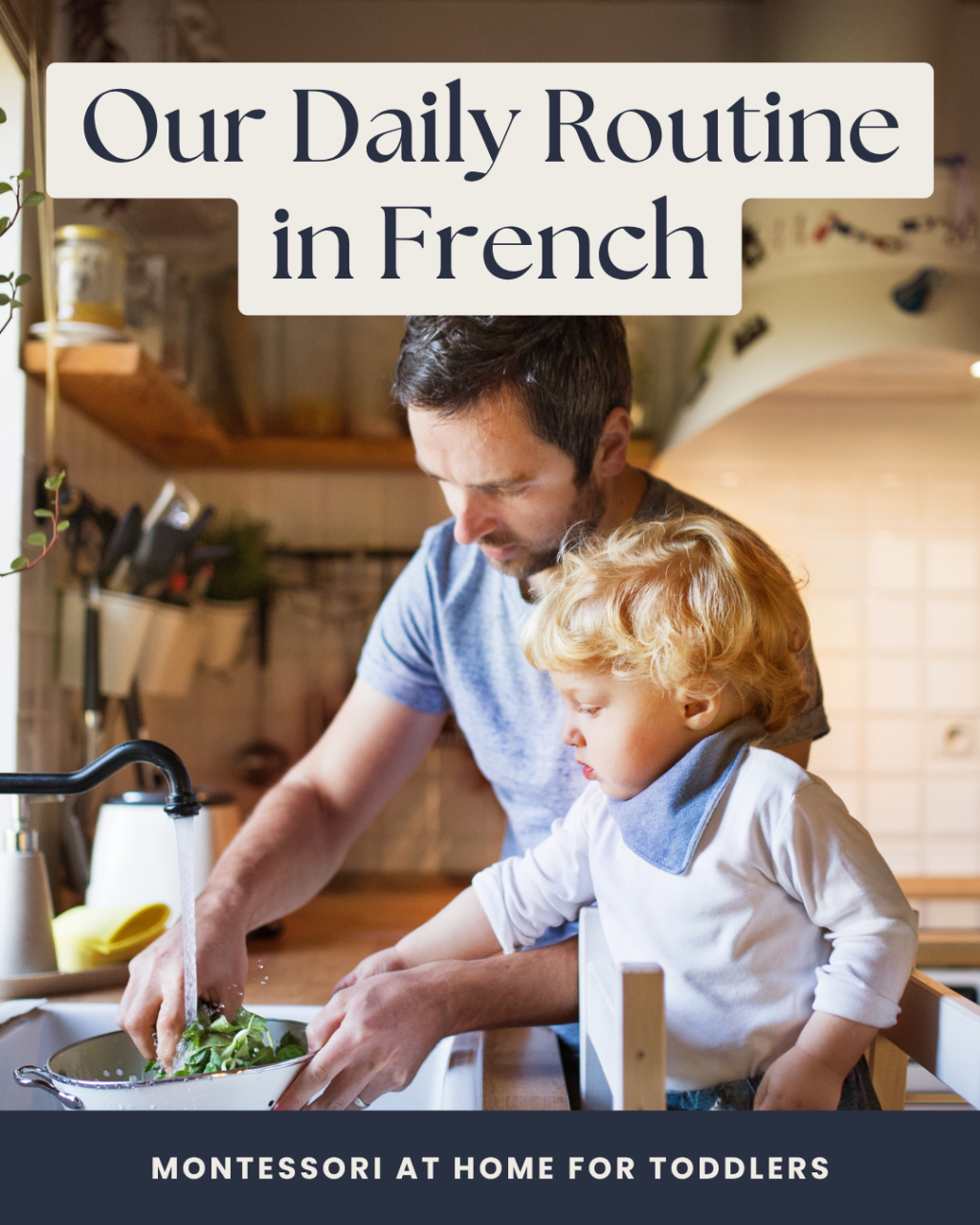
One way that I love to do the Montessori method at home while also getting in some French immersion is being in the cuisine ! An easy, but messy, way to do that is to have your toddler casser des œufs (cracking eggs). You can count the amount of eggs you can use, it gives your child a fun sensory experience, and cooking in the kitchen always brings about fond memories. I’ve also had my toddler beat the eggs and pour ingredients for other recipes such as pancakes. Whatever foods your toddler enjoys, find a way for them to safely prepare with you. This is a language-rich experience where the child can unconsciously take in the language.
Depending on our morning, we’ll either take a walk, go to the park, see some friends, or do some shelf work. I purposefully keep my days lightly planned. While children do need structure, they don’t need every single minute planned out. Overstimulation is a real thing, for both your child and you. When we give our children time to be bored, they can build their creativity, independence, and their concentration.
Only you know your child best. Through observation, you can know how to plan and structure their day.
Whenever we do outings, I still make sure to use the minority language. I make sure to give my children as much exposure as possible, but I also want to model that it’s okay, and normal, to speak multiple languages, even in an area where one language dominates.
Lunch Routine
Since I feel like my toddler is capable of this, my toddler will grab our ceramic plates for lunch time. One of my top phrases is “À table !” and I will ask my toddler to grab a plate with both hands. I have plates and bowls in an accessible spot (away from younger sibling), that my toddler can get to in the kitchen.
While most Montessorians would say its best for children to eat at a child-sized table, we use the Abviie highchair for both of our kids so we can all sit together as a family. We love how versatile these chairs are!
Although they start off as high chairs, you can remove the child seat off of them and use it as chair. My husband actually sat in it the other day and thought it was quite comfortable. It comes with an attachable tray, but I like to remove it sometimes so my youngest can eat at the table with the rest of the family. My toddler can also climb up onto her high chair with supervision and some assistance. Bonus for independence! They’re considerably cheaper compared to other high chairs and the wood is high quality.
We recently bought a child-sized table and chairs (mainly for crafts and snacks), and it’s nice to give my toddler the choice of sitting at the petite table or the grande table. The only downside is that my children fight over which chair is theirs…they’re both the same chair!
Between each transition, I typically sing the song, “C’est le temps de ranger“. Music helps my kids transition from one activity to the next, and if I don’t have a song I know, sometimes I just make up the lyrics for the fun of it.
A phrase that I typically use to say it’s nap time is, “On va faire une sieste !” or “C’est l’heure de la sieste !” I’ll then ask my toddler if they would like to “marcher comme un ours” or “sauter comme une grenouille” to their room. This gives freedom within limits while also making it fun. But there are those days when toddlers aren’t in the mood for playing around, and when those days happen, I lovingly pick up my toddler and help them get to their room.
Nap Time
Singing songs is one of the simplest ways to create language-rich moments with your toddler. It’s so amazing when they start singing along as well. My heart melts every time! Some songs I like to sing are:
It’s always good to practice the lullaby songs you want to sing often so when you’re with your child, they can hear and sing along. But it can take a while to get there and sometimes all you can do is hum along or make up your own words until you know the lyrics.
As always, I say the usual, “Je t’aime.” or “Je vous aime” and give some câlins and bisous with a simple “Au revoir.” Then, I like to take some time to relax. It’s such an important part of the day!
Afternoon Activities
Depending on what time my kids get up from a nap, I typically like to have them play outside and if it’s warm out, we do some water activities. Squeezing a sponge is a great yet simple practical life activity and it helps strengthen the hand. Here are some phrases or vocabulary words that I typically use when we’re outdoors:
- “On va dehors !” // “We’re going outside!”
- “Regarde! Tu vois l’avion ?” // “Look! Do you see the airplane?”
- “C’est un papillon !” // “It’s a butterfly!”
- “Est-ce que tu vois le lapin ?” // “Do you see the rabbit?”
- “Quel temps fait-il aujourd’hui ? Il fait chaud !” // “What’s the weather today? It’s hot!”
Evening Routine
We always try to make sure dinner can be a time for the family to reconnect after a long day. While my husband does know some French, he will mostly speak English to our kids with some French sprinkled in there. I will talk to the kids in French, but I’ll talk to my husband in English. Although, I will tell my husband things in French, but that’s because his comprehension is a bit stronger than his output.
One way I incorporate French into dinner time is by presenting options such as, “Tu veux de l’eau ou du lait?” (You want water or milk?”) or “Tu veux un bol ou une assiette?” (You want a bowl or a plate?”). By doing this, your child is then encouraged to produce more language rather than answering yes or no.
Other phrases we use in the evening are:
- “Il est temps de débarrasser la table.” // “It’s time to clear off the table.”
- “Mets ton assiette dans le lave-vaisselle s’il te plaît.” // “Please put your plate in the dishwasher.”
- “Au bain !” // “Let’s take a bath!”
- “Tu veux laver ton corps ou moi ?” // “Do you want to wash your body or me?”
- “On va se brosser les dents.” // “We’re going to brush our teeth.”
- “Où est ton pyjama ?” // “Where are your pajama’s?”
- “Au lit !” // “Let’s go to bed!”
- “Bonne nuit.” // “Goodnight.”
At the 0 to 3 stage (even the 3-6 stage), language is very simple. You can sprinkle in different syntax structures and flowery vocabulary, but the most important thing for your child is having meaningful interactions in the language. Whatever your language level, you can have meaningful interactions with your child even if you only speak French during certain periods of the day. Here is a little sample of what you could do if you’re learning French alongside your little one:
- Getting dressed: English
- Breakfast: French
- Play time: English
- Outside: French
You can honestly choose which parts of the routine you want to speak French or English in. Being a parent is already a tough mental load, and adding in another language can feel overwhelming! Go at the rate that you need to, and the more you use it, the more it will naturally flow.
The last thing I will say is that language learning isn’t linear. It’s very much up and down and at times you might feel like you need to take a break. That is always a valid choice! Although it can feel lonely at times, remember you’re not the only one on this language learning journey. Until next time!
 P'tit jardin Montessori: Montessori in french
Leave a comment