
Start Where You Are
Many people say raising children in a language that isn’t your own is too hard, too risky, too confusing, too much, but I’m here to tell you that it’s not impossible. It is so worth it.
If you’re reading this article, perhaps you are currently debating on if raising your child in a second language that you’re not completely comfortable with is a valid choice. Questions like, “What if my child learns things incorrectly?” or “What if this will harm my child?” might quietly chip away at your confidence.
I cannot tell you how many times I told my husband, “That’s it! I’m done with French, I’m not good enough.”
I’m a perfectionist by nature, and while I know perfection is utterly unattainable, I still desire to reach it and to push myself to get there at the expense of my sanity. Once I get back to a clear space of mind, I realize how silly I was for placing such crazy expectations on myself and comparing my abilities to others. It never helps— and yet I fall into this trap more often than I’d like.
There have been so many times where I felt like I couldn’t raise my children only speaking to them in French because it wasn’t my native tongue or even my heritage. I felt like a fake. And yet, I keep going because of my deep love for French language and the value I place on bilingualism.
It was my junior year of high school that I started to feel seriously drawn to study French. I had been studying it since my freshman year, but something about it just clicked for me. I wasn’t the best language learner by any means, but I really enjoyed the content of my class and I knew I wanted to keep up with it and hopefully have my kids learn it. As a high school student, I did not think about the logistics of what it would actually be like to only speak French to my children!
In all of my French high school and college courses, no one ever covered how to say “bib” or “bottle”. I quickly realized how much depth there really is to a language.
This realization always reminds me of what one of my French professors said, “The more you know, the more you realize you don’t understand.” Crazy, huh?
It’s okay to not understand everything. We do it all of the time in our native language! No one ever speaks perfectly— even in their own language. We make mistakes when we write, we struggle to understand complex books, and when we usually mishear someone, we just ask them to repeat it. We don’t immediately think, “How stupid am I for not getting it the first time?”— so why should learning a second language be any different?
Little Language Moments Add Up
Regardless of your language level, you can start weaving the target language into your daily routine through small, consistent actions:
- Labeling everyday objects around the house
- Listening to music, podcasts or audiobooks in the language
- Switching your phone or favorite apps into the language
- Choosing one routine (breakfast, bath time, or getting dressed) to always do the target language
It’s okay to start small. We’re all going through different seasons of life, and what feels easy one season may feel overwhelming the next. What matters most is creating positive, joyful moments in the language with your children. Those little moments really do add up.
Play in the Language
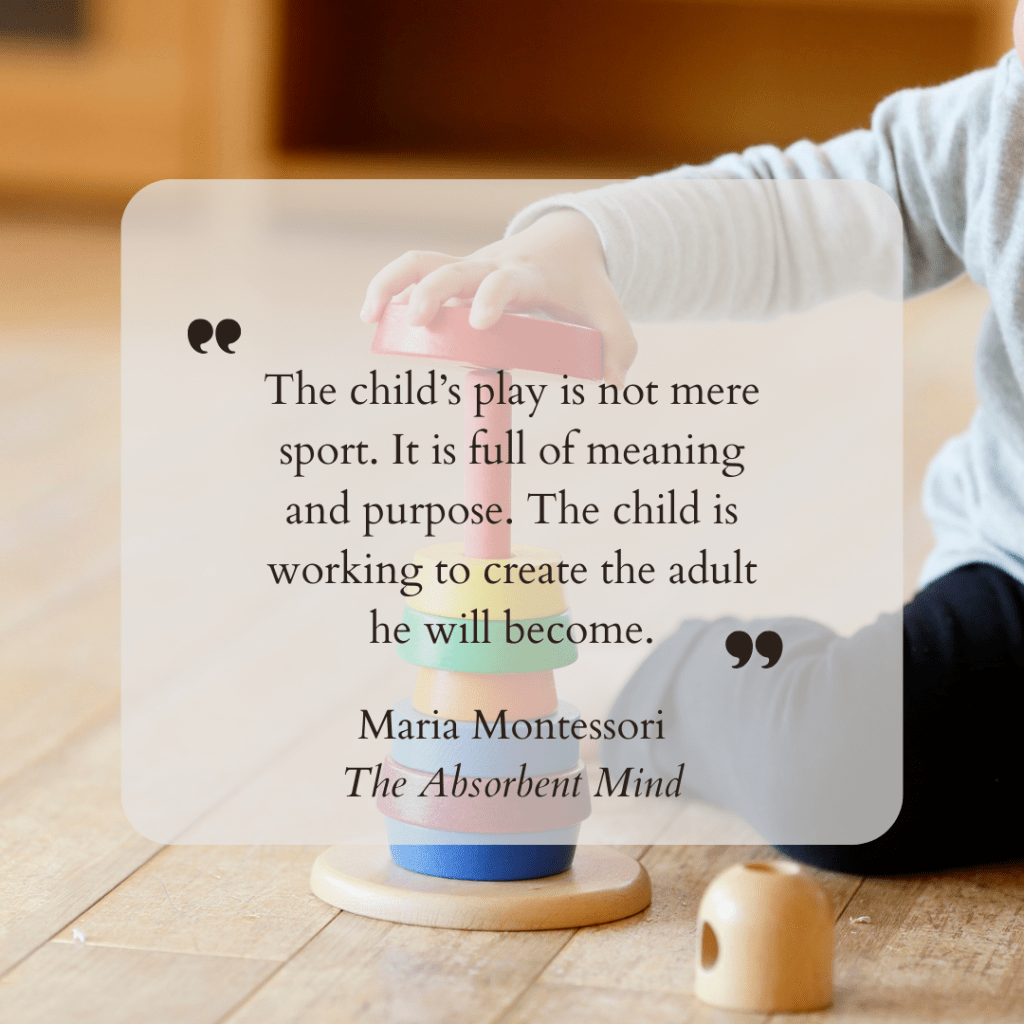
As Dr. Maria Montessori once said, “Play is the work of the child.” Whenever I watch my children deeply engrossed in an activity or a toy, I can see that there is so much going on in their little minds. With each setback, repetition, and success, children are absorbing every experience they have, and we might as well naturally prepare an environment invites the child to complete his work in the target language. The prepared environment you create will vary depending on your child and your language abilities. Remember that it’s always better to start small and then to slowly add on rather than trying to do everything right away.
Here are some things you can do to incorporate French into your daily life:
- Sing simple songs (I love this song for cleaning up – C’est le temps de ranger)
- Read books aloud, even if you’re pronunciation isn’t perfect
- Use puppets or dolls
- Play different games like hide-and-seek (cache-cache) and red light, green light (feu rouge, feu vert)
Grow on Your Language Journey
As parents, we have so many responsibilities that we often forget how essential it is to take care of ourselves, especially our own language learning. It can feel so overwhelming to add another thing to the list, and it can feel discouraging when we don’t get everything checked off.
When possible, carve out some time to practice your language skills. Some simple things I like to do include putting on France 24 in the mornings, or listening to a podcast in the background while driving or doing dishes. I love the podcast Toudou on France Inter. This podcast is for 2 to 4 year old and is about adventures of a cherished lovey, named Toudou, who comes to life. Children listen about Toudou’s experiences such as being at the farm, the forest, and the beach. There’s also a parent-focused segment called Les notices de Toudou where the creators of the podcast answer parenting questions and how to reinforce what your child hears in the story.
This is a fantastic podcast for anyone with littles at home, but also for parents who are learning the language alongside their child. The language is simple, clear, slow, and closely mirrors how you would speak to a toddler.
A quick tip that I have for language learners: get in the habit of repeating aloud the words and phrases you hear while listening. This turns passive listening into active learning. Since the episodes are so short, I would highly recommend listening to them over and over again. The more you come into contact with new words, the more it will stick!
Another tip: write down what you hear and create your own personal dictionary so you can add it to your vocabulary. I have a mini whiteboard on my fridge where I write down any words or phrases that I want to use. I see them everyday, say them aloud whenever I remember, and I’ll eventually erase the definition to test myself. Once I feel confident with that word or phrase, I erase it and add more.
When acquiring a language, it’s beneficial to have a balance between reading, writing, listening, and speaking. However, this can be pretty tricky when our lives are so hectic! So, watch a few Youtube shorts in the target language or watch some Francophone Youtube creators. There is so much free content out there in French! Tubi has some shows and movies that are in French with subtitles in English. Unfortunately, Tubi doesn’t have any subtitles in French, but if you’re watching something on Youtube, you can get French subtitles there.
Above all, be kind to yourself and know that language acquisition isn’t linear. Just like children need time to acquire language, we need time as well. Celebrate how far you’ve come instead of wishing you would be further along. I know it’s easier said than done, but take comfort in knowing that you’re not alone. Every little moment counts.
Your Effort is Meaningful
The little moments you spend with your child do add up. Whether that’s a simple “Bonjour” or your child curling up in your lap as you read a story in French, your child will be able to feel your love through the language. Language is all about connecting, so it’s important you can find ways to do that (imperfect grammar and all) even if it’s through simple means.
I hope you found this article helpful and that is can be a source of hope as you continue on this journey. Please feel free to comment down below any questions, thoughts, or encouragement to others. If you would like, I also have a freebie right here on “10 Easy Phrases to Start Using at Home Today”. These simple phrases are a fantastic way to slowly implement French at home through meaningful routines. 👉 Click here to get your free 10 French phrases.
Bonne journée !
 P'tit jardin Montessori: Montessori in french
Leave a comment